

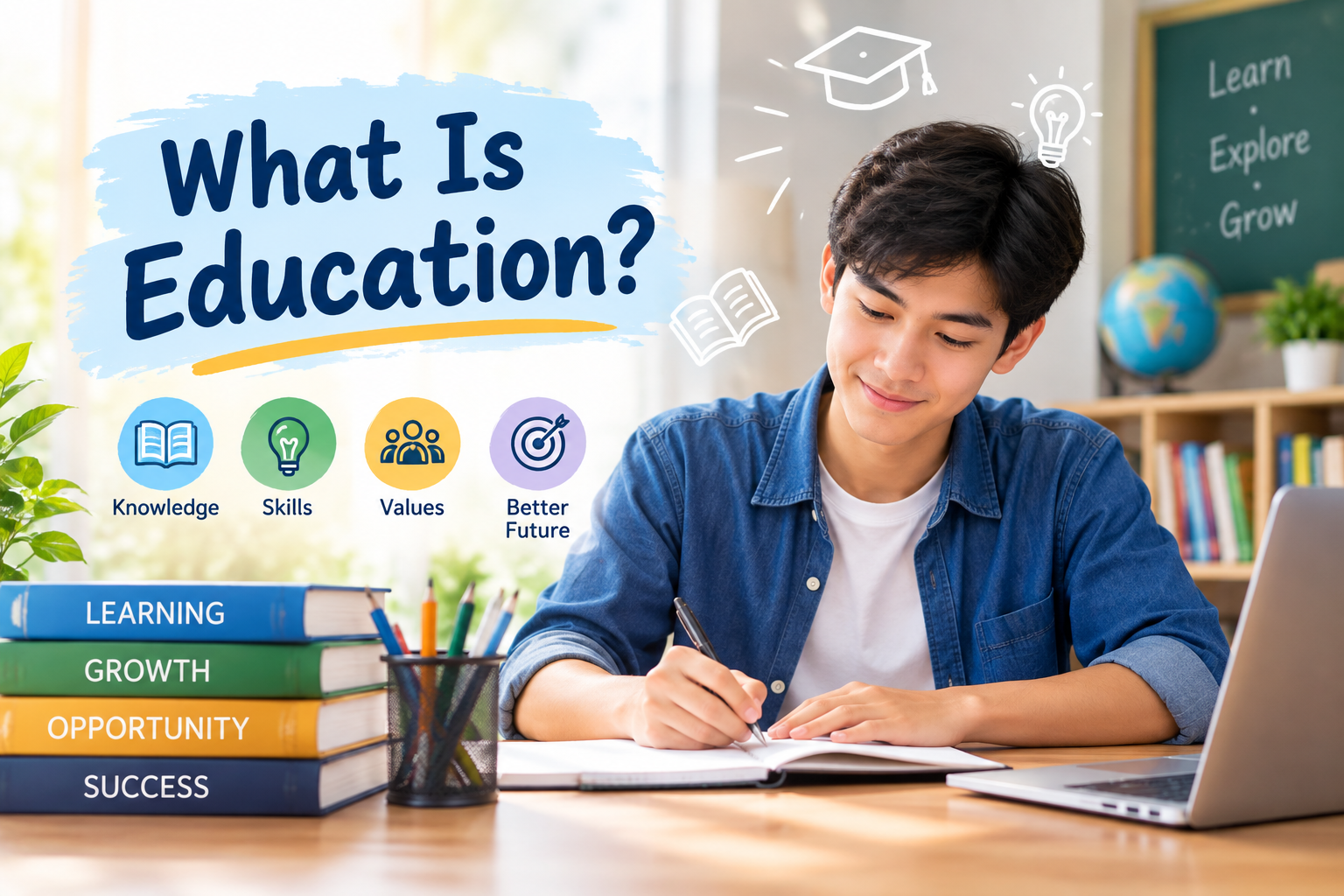
Education is a part of human life. Education helps people grow knowledge, skills, values, attitudes and the ability to make choices. Even though education is often linked to schools and universities learning starts before formal schooling and goes on for life.
What exactly is education? I wonder why education matters. What are the different types of education. How does education shape individuals and society?
This article explains what education means, its main goals, the forms it takes the benefits it offers and its role in personal and professional growth.
Education is the process of gaining knowledge, skills, values, attitudes and understanding through learning and experience.
Traditionally education happens in schools, colleges, universities and other formal institutions.. Education also happens at home at work through online courses, community events, books, conversations and everyday moments.
In terms education is the process of learning that helps people understand themselves other people and the world around them.
Education is not about memorizing facts. Good education also teaches people how to think, solve problems, talk, work together judge information and use knowledge in life.
Education plays a role in how individuals grow and how society moves forward. Its importance shows up in areas.
One of the goals of education is to give knowledge.
Students learn subjects like math, science, languages, history, technology, economics and social studies. This knowledge gives people a base for understanding the world.
Knowledge can also help people make choices in everyday life.
Education is not about facts. Education also helps people build thinking skills.
Examples include:
These skills can be useful in education, jobs, business and daily life.
Today education focuses more on analyzing information than memorizing it.
Critical thinking allows learners to ask questions such as:
These skills are especially useful when people have access to amounts of information online.
Education can help people discover their interests, strengths and goals.
For example a student who studies science may find a love for research. Another student may find a passion for business, teaching, technology, farming, art or another area.
Learning can therefore become a path for people to see what they want to do with their lives.
Education and professional training can ready people, for jobs and starting businesses.
Some jobs need degrees while others rely more on technical skills, experience, certificates or training.
Because of this education can be a part of career growth.
Education can be split into categories. The three main forms are non-formal and informal education.
Formal education is organized learning offered by recognized schools and colleges.
Examples include:
Formal education usually follows a plan has teachers, books, tests and set learning levels.
Students may earn certificates, diplomas or degrees after finishing programs.
Non-formal education happens outside the school system but is still organized and planned.
Examples include:
Non‑formal education can be very useful for people who want to learn skills without joining a regular school program.
For example a person who likes marketing might take an online class instead of studying a marketing degree at a university.
Informal education happens through everyday life and experiences.
People learn informally through:
Informal learning can happen without a set curriculum or a teacher.
For example a person can learn to fix a home appliance by watching tutorials and practicing at home. Even if this does not give a certificate the person gains useful knowledge and skills.
The purpose of education can differ for each person, culture, community and education system.
However many people see reasons for education.
Education helps learners grow their skill to understand, analyze, judge and use information.
Education can give knowledge and skills that matter for jobs. Starting a business.
Learning places let people practice talking and working with others.
Education can push people to keep learning after school.
Education can help people see duties, social ties, moral issues and their place in communities.
Technology has changed how people learn.
Before students mostly used books, classrooms, libraries and teachers in person. Now learners can get learning material on computers and phones.
Examples include:
This change has put learning material in the hands of many people no matter where they live.
Technology also brings problems. Learners must check information carefully because not everything online is true or trustworthy.
So digital skill is now an important part of today’s education.
Online learning lets students study via the internet of only in real classrooms.
An online class can have video lessons, reading material, quizzes, tasks, discussion boards and live talks.
Online learning can be useful for:
One good thing about online learning is flexibility. Learners can study when and where suits their schedule.
Good online learning also needs discipline, steady internet, good learning material and the skill to manage time alone.
Education does not stop when a person graduates from school or university.
The world today changes fast. Tech, jobs and ways of working keep coming.
Because of this lifelong learning is more important than ever.
A person may continue learning through:
Lifelong learning lets people renew knowledge and grow skills at every life stage.
Good learning is not about giving lots of facts.
Effective learning should help students grasp ideas and use them.
Several factors can contribute to learning:
Students should know what they are supposed to learn.
Books, videos drills, examples and other tools should back the learning goals.
Students usually gain from asking questions practicing skills talking ideas and solving problems.
Helpful feedback can show students where they err and help them grow.
Using knowledge, in life can make learning more meaningful.
Education should urge students to see learning as a never‑ending path.
Education can shape career growth in ways.
First formal qualifications may be required for professions. Second specialized training can help people acquire skills. Third continuing education can help professionals keep education knowledge current.
For entrepreneurs education can also provide knowledge about:
However education is one part of career development. Practical experience, networking, personal initiative, adaptability and professional skills can also be important.
Education affects not individuals but also communities and societies.
An educated population can contribute knowledge, skills, innovation, research, entrepreneurship and professional services.
Schools and other educational institutions can also serve as places where people learn to communicate and cooperate with individuals from backgrounds.
Education therefore has both an individual and a social dimension.
Despite its importance education faces challenges.
These may include:
Different countries and communities face different combinations of these challenges.
Addressing them may require cooperation between governments, educational institutions, teachers, families, communities, businesses and technology providers.
You do not have to wait for a course to start learning.
Here are several practical strategies.
of saying, “I want to learn business ” create a more specific goal such as, “I want to understand basic digital marketing within three months.”
Books, websites, academic materials and professional publications can expand your knowledge.
Online courses can provide learning in areas ranging from business and technology to languages and professional skills.
Knowledge becomes more useful when you apply it.
For example someone learning web development can build a website. Someone learning marketing can create a marketing campaign.
Questions are a part of learning. If something is unclear investigate it than simply memorizing information.
Regularly reviewing what you have learned can help you identify gaps and determine what you should study next.
Education is the process of learning knowledge, skills, values and understanding through schooling, training, experience and everyday life.
Education can help people develop knowledge, skills, critical thinking, communication abilities and preparation for professional life.
The three discussed types are formal education, non-formal education and informal education.
No. School is one form of education. People can also learn through work, books, online courses, training, family, communities and everyday experiences.
Lifelong learning is the process of acquiring knowledge and skills throughout a persons life including after formal schooling has ended.
Online education can be effective when the course is well designed and the learner has resources, engagement and discipline. Its effectiveness depends on the subject learning method, learner and quality of the program.
Education is much more than attending school and passing examinations. It is a process through which people acquire knowledge develop skills explore ideas solve problems and understand the world around them.
Formal education provides learning while non-formal and informal education provide additional opportunities to develop knowledge and practical abilities.
In a changing world education can continue throughout life. Whether through a university degree professional training, a course, reading, work experience or independent study learning can help individuals adapt and pursue their personal and professional goals.
Ultimately education is not simply about what a person knows. It is also about developing the ability to learn think, apply knowledge and continue growing.
Ultimately education is not simply about what a person knows. It is also, about developing the ability to learn, think, apply knowledge and continue growing.
Education is no longer limited to classrooms, chalkboards and books. The changing digital world is changing how we teach and how we learn, drive...
Artificial Intelligence in the Classroom: Opportunities and Challenges Artificial intelligence (AI) is quickly becoming part of life and educati...
What Are Online Courses? A Complete Guide for Beginners Online courses are programs that people can take through the internet instead of going t...
What Is Education? Definition, Importance, Types and Benefits Education is a part of human life. Education helps people grow knowledge, skills, ...
What Is Effective Learning? Definition, Strategies and Benefits Learning is a part of education and personal development. However simply spendin...

No comments yet.