


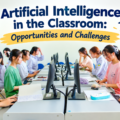
Artificial intelligence (AI) is quickly becoming part of life and education is not different. From AI tools that help with learning to AI systems that can explain ideas create practice questions and help with planning lessons artificial intelligence is changing the way teachers and students work together to learn.
The use of AI in education brings possibilities but it also brings important questions about honesty in schoolwork, privacy, fairness, accuracy differences in access to technology and the role of teachers.
The aim should not be to use AI just because the technology’s there. Instead schools and teachers need to think about how AI can help with learning while keeping human judgment and student independence.
UNESCO describes AI as a technology that can offer chances for learning that is tailored to each student and teaching support but also brings problems involving ethics, protecting data, fairness and education that focuses on people.
Artificial intelligence in the classroom means using AI tools to help with teaching, learning, testing, managing or other educational activities.
Examples include:
For example a student who is having trouble with a math idea might use an AI learning assistant to get another explanation or more questions to practice.
A teacher might use an AI tool to come up with lesson ideas or make versions of an exercise for students with different needs.
Ai should help with education not take the place of thinking and learning.
One of the opportunities from AI is learning that is tailored to each student.
Students have abilities, backgrounds, interests and how fast they learn. A regular classroom may not let a teacher give individual help to every student.
AI learning systems can possibly look at how a student interacts and give exercises, explanations or support.
For example a student who knows algebra but has trouble with equations could get more practice focused on that area.
Personalization could mean students get help that fits their learning needs better.
AI tools can give help when school is not open.
Students might use AI to ask questions get explanations practice a language or go over ideas.
This does not take the place of teachers. It can be an extra learning tool.
UNESCO has said that personalized help and learning support from AI can be good. They also say it needs to be done carefully.
AI can also support teachers.
Teachers spend a lot of time making materials creating questions organizing information and doing tasks.
AI may help with things like:
This could let teachers spend time on things that need human contact like helping students having discussions building relationships and giving individual support.
The OECD says that teachers are still important in education and need training to use new tools well.
AI may also help make learning easier for people.
Tools that turn speech into text text into speech or translate can help students with needs.
For example a student who finds it hard to read a lot of text might benefit from listening to learning materials.
AI translation can also help students get information in languages they do not fully understand.
Accessibility depends on whether the right tools are actually available and affordable.
AI is becoming something that students need to know about.
Modern education may need to teach students not how to use AI. Also how it works what it cannot do and what ethical issues it raises.
The 2026 OECD/European Commission AI Literacy Framework describes AI literacy as knowing being able to do and having the attitude to understand AI check its answers carefully and use it in a good and creative way.
UNESCOs AI skills framework for students also includes thinking that puts people first AI ethics, how AI works and how to design AI systems.
AI also brings problems that schools must think carefully about.
One of the problems is using AI to complete school tasks.
If a student asks an AI to write an essay and then gives it as their work the student gets a complete answer without gaining the skills of writing, researching and thinking critically.
This makes a difference:
Using AI to help with learning is different from using AI to avoid learning.
Schools may need to change assignments so students show their thinking, research, discussion and real application.
AI systems can give answers that seem correct but are not.
A student might think an AI answer is right just because it sounds sure.
This makes checking facts an important skill to learn.
Students should ask:
Thinking critically becomes more important as AI is easier to use.
AI learning tools may deal with student information.
Depending on the tool this could include what a student does what they say, what they do for school or other personal details.
UNESCOs advice on AI in education highlights the need for privacy and keeping people at the center when using AI.
Schools must then understand what data an AI system takes, how it uses it and what protections are in place.
Another worry is using AI for everything.
If students use AI for every question they may not get the chance to work things out on their own explore and build their thinking.
AI should act as a helper for learning, not a replacement for thinking.
For example of turning to AI right away a student could try to solve a problem alone and then use AI to check mistakes or learn a different way.
Not every student has the chance to use devices, internet or advanced AI tools.
This can make a AI gap* along with the usual gap in access to technology.
UNESCO has said that unequal access to tools and AI is an important concern for the future of education.
If some students have access to learning tools and others do not inequality in education could get worse.
Teachers need training to use AI well.
Knowing how to use an AI tool is not the same as knowing how to use it in teaching.
Teachers need to understand:
UNESCOs teacher skills framework includes areas like AI ethics, the basics of AI, how to teach with AI and ongoing learning.
Students can use AI as a partner in learning not as a tool to get answers.
Useful ways include:
of telling AI to finish a task ask it to explain a hard idea.
Students can ask AI to create questions and then try to answer them on their own.
AI can sometimes give feedback on writing, thinking or how something is organized but important work should still be checked carefully.
Students can ask AI to explain an idea in ways and then check the facts using reliable sources.
AI information should not be taken as the truth automatically.
The coming of AI does not make teachers less important.
Teachers bring relationships, encouragement, context, judgment, guidance and experiences of learning with others.
UNESCO has said that teachers are still very important in education and that AI should be used in ways that keep people in charge.
The job of a teacher might change.
Of being only the person who gives information teachers may become more:
Technology can give information. Real learning also needs human interaction.
Schools that want to use AI can set rules.
Students and teachers should know when AI is allowed, when it is not and when it is not allowed.
Students should learn about what AI can do what it cannot do, ethics and how to use it properly.
Schools should carefully look at privacy and safety before using AI tools.
decisions should not be made only by machines.
Technology should be used because it helps with learning not just because it is new.
Professional learning should go with technology changes.
It can offer learning that is tailored to each student help teachers in their work make learning easier for people offer more chances to practice and allow students to learn new skills related to technology and artificial intelligence.
At the time AI brings up problems related to honesty in schoolwork, wrong information, privacy issues, unfair advantages relying too much on technology and the need for teachers to learn how to use AI properly.
The main question is therefore not whether schools should use AI in every situation.
The better question is:
How can AI be used to make learning while keeping students, teachers thinking critically and human judgment as the most important parts of education?
The future of AI in the classroom will rely not on how strong the technology is but also, on how carefully teachers and students use it.
AI can offer tools. Education has to decide how those tools are used.
Primary source
Education is no longer limited to classrooms, chalkboards and books. The changing digital world is changing how we teach and how we learn, drive...
What Are Online Courses? A Complete Guide for Beginners Online courses are programs that people can take through the internet instead of going t...
Artificial Intelligence in the Classroom: Opportunities and Challenges Artificial intelligence (AI) is quickly becoming part of life and educati...
What Is Education? Definition, Importance, Types and Benefits Education is a part of human life. Education helps people grow knowledge, skills, ...
What Is Effective Learning? Definition, Strategies and Benefits Learning is a part of education and personal development. However simply spendin...

No comments yet.