

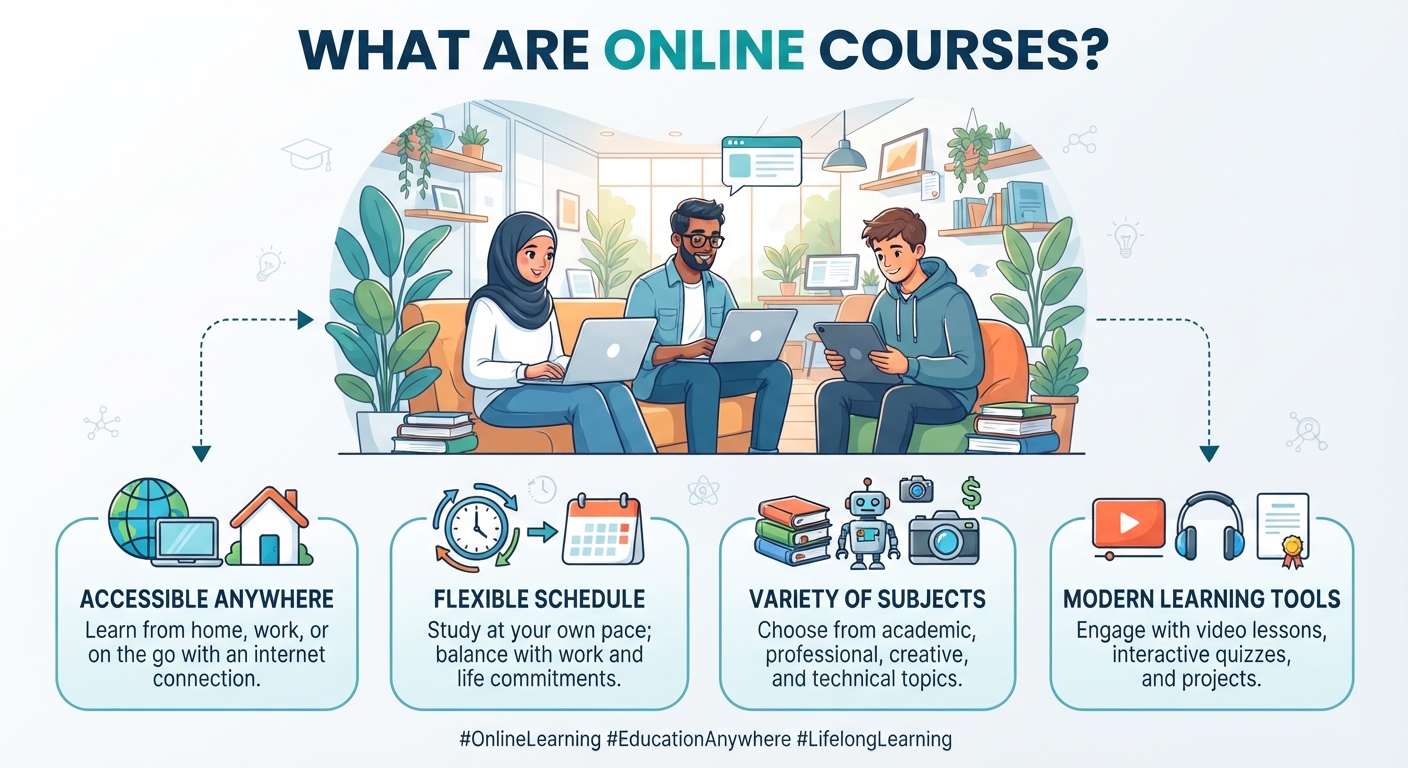
Online courses are programs that people can take through the internet instead of going to a traditional classroom. They let learners study from home at work or almost anywhere with an internet connection.
Online courses have become a part of modern education because they offer flexibility, accessibility and many learning opportunities. Students can learn subjects, professional skills, technology, business, languages, creative skills and many other topics through online learning platforms.
An online course usually provides learning materials through a website or learning platform. Depending on the course students might receive:
*. Tests
Some courses are completely self-paced. This means students can decide when and how quickly they want to study.
Other courses follow a fixed schedule. Students may need to attend classes, complete assignments by specific deadlines or take part in discussions with instructors and other students.
One of the reasons people choose online courses is flexibility.
Traditional education often requires students to travel to a place and follow a set schedule. Online courses can reduce these limits.
For example someone who works during the day may be able to study a course in the evening. A parent may study after taking care of their family. A business owner may learn skills without taking much time away from their business.
Online learning can also provide access to courses that may not be available locally.

Any subject can be taught online.
Online courses can teach subjects such as:
These courses can be useful for people who want to start or improve a business.
Technology courses are another category of online education.
Learners can study:
These skills can be useful for students, professionals, freelancers and business owners.
Language courses can help students learn:
Many language courses combine videos, exercises, pronunciation practice and interactive activities.
Online courses are also available for development. Topics may include:
Creative courses can teach practical skills such as:
courses provide several potential benefits.
Students can often choose when they study. This makes online courses suitable for people with work, family or other responsibilities.
Online education allows learners to access materials from different locations. A student does not necessarily need to live near a university, training center or instructor.
There are courses covering thousands of subjects. Learners can choose courses or advanced programs depending on their goals.
Many online courses allow students to pause, replay and review lessons. This can be particularly useful when learning concepts.
Some online courses focus on skills that can be used directly in work or business such as marketing, programming, design, accounting or project management.
Some online courses are free while paid courses can sometimes cost less than traditional classroom-based education. However prices and quality vary considerably.
No. An online course and an online degree are not necessarily the same.
An online course may take a hours, several weeks or several months to complete. It may provide a certificate of completion. Does not necessarily represent an academic degree.
An online degree on the hand is an academic program offered by an educational institution and normally involves a structured curriculum, admission requirements, examinations and other academic requirements.
Before enrolling learners should check what credential or certificate the provider offers.
With thousands of online courses available choosing the right one can be challenging.
Consider the following factors:
Start by asking:
What do I want to learn and why?
For example someone interested in marketing may want to learn SEO, content marketing, social media marketing or paid advertising.
A clear goal makes it easier to choose a course.
Look at the topics covered by the course.
A good curriculum should provide information for you to understand what you will actually learn.
Look at the instructors background, experience, qualifications and teaching history.
For subjects practical experience can be particularly valuable.
Reviews can provide information about the learning experience.
However do not rely on ratings. Read reviews and look for recurring comments about course quality, teaching style, assignments and usefulness.
Determine whether the course is:
Choose the format that fits your schedule and learning preferences.
If certification is important to you find out what type of certificate the course provides and who issues it.
A “certificate of completion” is different from a certification or an accredited academic qualification.
Compare the course price with the content, instructor expertise learning resources, support and certificate offered.
The expensive course is not automatically the most suitable course.
Online courses can be useful for people who want to develop professional skills.
For example an employee working in marketing might take a course in data analytics. A small business owner might study marketing. Someone interested in changing careers might begin learning programming or web development.
However completing a course does not automatically guarantee employment or career advancement. The value of a course depends on factors such as the quality of the education the learners skills, practical experience, portfolio, qualifications and the requirements of the relevant employer or industry.
Whether an online course is worthwhile depends on the learners goals and the quality of the course.
A designed course can provide structured learning and help someone develop knowledge or practical skills. However learners should research the course carefully before paying for it.
Look beyond marketing claims. Examine the curriculum, instructor, reviews, learning format, practical assignments and credentials.
An online course is an training program delivered through the internet. It may include videos, reading materials, assignments, quizzes, live classes and other learning resources.
Yes. Many online courses are specifically designed for beginners. Look for courses that clearly identify their required prerequisites and starting level.
Yes. Some educational platforms and institutions offer courses. Others offer paid courses or provide introductory materials with paid certificates or advanced content.
Many do,. Not all certificates have the same value. Check who issues the certificate and whether it represents completion, professional certification or an academic qualification.
It depends on the course. Some can be completed in a hours while more comprehensive programs may take weeks or months.
They can help learners develop knowledge and skills to certain careers. However career outcomes depend on factors, including the learners experience, portfolio, qualifications and the requirements of the employer or industry.
Online courses provide a way to learn knowledge and develop practical skills through the internet. They cover a range of subjects from business and technology, to languages, creative skills and personal development.
Before choosing a course consider your learning objectives, curriculum, instructor, reviews, course format, certificate and cost. Importantly choose a course based on what you genuinely want to learn and how you plan to use that knowledge.
For learners who approach education with clear goals and consistent effort online courses can become a useful part of lifelong learning and professional development.

What Is Education? Definition, Importance, Types and Benefits Education is a part of human life. Education helps people grow knowledge, skills, ...
What Are Online Courses? A Complete Guide for Beginners Online courses are programs that people can take through the internet instead of going t...

What Is Effective Learning? Definition, Strategies and Benefits Learning is a part of education and personal development. However simply spendin...
Education is no longer limited to classrooms, chalkboards and books. The changing digital world is changing how we teach and how we learn, drive...

Artificial Intelligence in the Classroom: Opportunities and Challenges Artificial intelligence (AI) is quickly becoming part of life and educati...

No comments yet.