

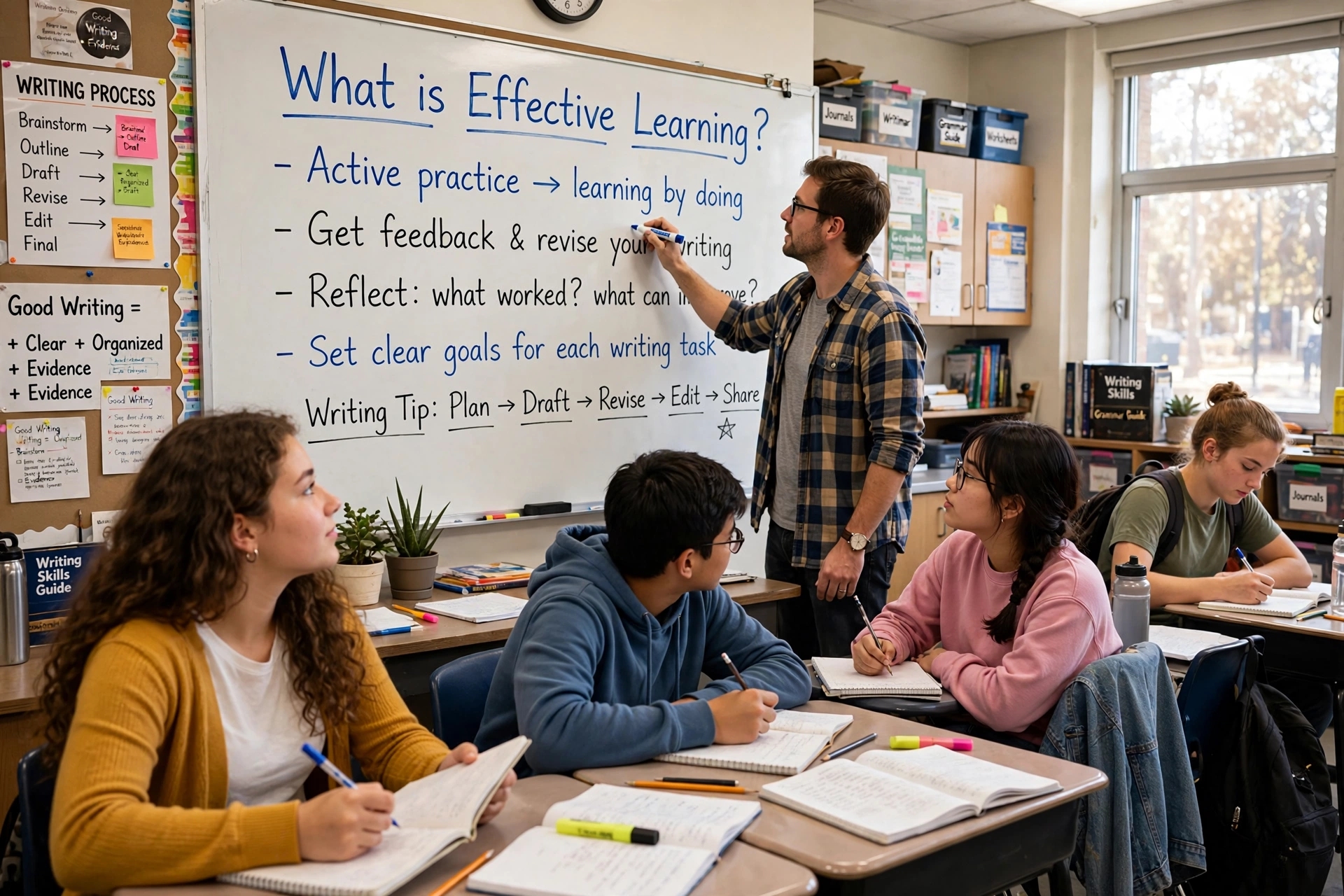
Learning is a part of education and personal development. However simply spending hours reading books watching videos or attending classes does not always mean that learning is effective.
Effective learning is a process in which learners understand, remember, apply and develop knowledge or skills in a way. It involves more than memorizing information. Effective learning helps people understand concepts, solve problems, practice skills and use what they have learned in real-life situations.
In todays world learners have access to an amount of information. The challenge is no simply finding information but knowing how to learn it effectively.
This article explains what effective learning means how it works, strategies, common mistakes and practical ways to improve your learning experience.
Effective learning is the process of acquiring knowledge, skills or understanding in a way that produces lasting results.
A learner who studies effectively does not simply memorize information for an examination. Instead they develop an understanding that allows them to explain, remember and apply what they have learned.
For example a person learning mathematics may memorize a formula. However effective learning occurs when the person understands what the formula means knows when to use it and can apply it to solve a problem.
In terms:
Effective learning means learning in a way that helps knowledge and skills become useful and lasting.
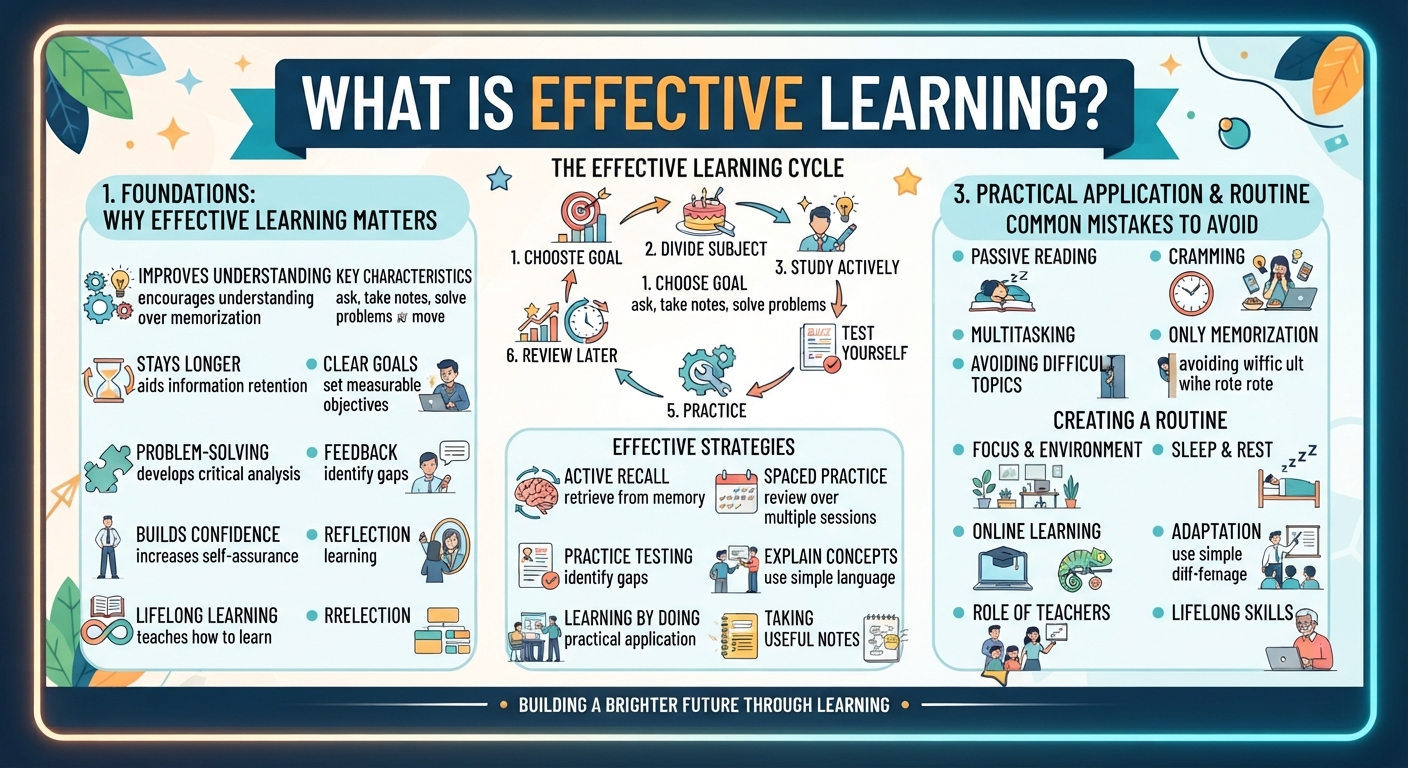
Effective learning can make education more productive and meaningful.
Effective learning encourages people to understand ideas of simply memorizing facts.
When learners understand the relationship between concepts they are more likely to remember and apply them.
Some learning methods may help people remember information effectively than repeatedly reading the same material.
Reviewing information over time practicing retrieval and applying concepts can strengthen learning.
Effective learning encourages learners to use knowledge in situations.
Of asking only “What is the answer?” learners can also ask:
These questions encourage thinking.
Understanding a subject can increase confidence.
When learners can explain a concept or successfully complete a task without relying on others they can develop greater confidence in their abilities.
Effective learning teaches people not what to learn but also how to learn.
This is particularly valuable because learning does not end when formal education ends.
Studying and learning are related,. They are not exactly the same.
Studying generally refers to activities such as reading textbooks reviewing notes watching lessons or completing exercises.
Learning refers to the development of knowledge, understanding or skills as a result of those activities.
For example a student could spend five hours reading a textbook. Remember very little afterward.
Another student might spend two hours reviewing, practicing, explaining concepts and testing their understanding.
The amount of time spent studying does not automatically determine how much a person learns.
The quality of the learning process matters.
Several characteristics are commonly associated with learning.
Learners should actively engage with the material.
Of only reading they can:
Active participation can make learning more meaningful.
Learning becomes easier to organize when learners know what they want to achieve.
Of setting a vague goal such as:
“I want to learn English.”
A specific goal might be:
“I want to learn 500 common English words and use them in everyday conversations.”
Clear objectives make progress easier to measure.
Practice is essential, for developing types of knowledge and skills.
A person learning programming must write code. A person learning a language must use the language. A person learning public speaking must find chances to speak.
Knowledge becomes more useful when knowledge is practiced.
Feedback helps learners find what knowledge they understand and where knowledge improvement is needed.
Feedback can come from:
Good feedback should help learners understand how knowledge can be improved.
Reflection means thinking about what knowledge has been learned.
After completing a lesson learners can ask:
Reflection can help turn learning activities into a continuous learning process.
There is no learning method that works perfectly for everyone. However several strategies can help learners study effectively.
Active recall involves trying to retrieve information from memory of simply rereading information.
For example after reading a chapter close the book. Try to explain the main ideas without looking at notes.
You can also create questions. Answer them from memory.
Examples:
This approach encourages the learner to retrieve information.
Spaced practice means reviewing material over sessions instead of attempting to learn everything in one long session.
For example than studying a topic for five hours in one day a learner might review it for shorter periods across several days.
This approach can make review more manageable. Can support long‑term retention.
Practice tests can help learners identify what knowledge they know. What knowledge they still need to study.
Practice questions can be created from:
The purpose is not simply to obtain a score. Practice testing can also reveal gaps in understanding.
One learning technique is to explain a concept in simple language.
Imagine that you have to teach the topic to someone who has never studied it before.
If you cannot explain it clearly that may indicate that your understanding is incomplete.
For example of memorizing the definition of photosynthesis try explaining what it means and why it is important.
experience can be particularly valuable for skill‑based subjects.
Someone learning photography should take photographs.
Someone learning web design should build websites.
Someone learning accounting should work through accounting problems.
Someone learning entrepreneurship can develop a business project.
Practical application connects knowledge with real‑world situations.
Large subjects can feel overwhelming.
Breaking a topic into sections can make learning easier to manage.
For example someone learning marketing could study:
of attempting to master everything at once the learner can progress through one area at a time.
notes do not need to contain every sentence from a lesson.
Instead notes should capture ideas, examples, questions, definitions and connections between concepts.
Different learners may prefer methods, including:
The useful system is usually the one that helps the learner understand and review the material.
Concentration is a part of learning.
Constant interruptions can make it harder to maintain attention and process information.
A simple learning environment might include:
Concentration can help the learner focus on learning activities.
A quiet environment can also help them maintain a tone.
The small‑talk is early‑
Learners do not have to study for long times. Short focused sessions are often better than trying to study for hours at a time.
Learning does not happen only when a person is studying. Sleep and rest are parts of a healthy learning routine. Fatigue makes it harder to concentrate process information and keep attention. For this reason learners should not treat sleep as something that can always be given up for study time. A sustainable learning routine must include rest.
Online learning gives flexibility. It also asks learners to take more responsibility for their own learning process.
Online courses can offer learning resources but simply enrolling in a course does not guarantee that learning will happen. The learner still has to engage with the material.
Some study habits may make it seem productive while not producing learning results.
Reading the material again and again can feel productive but it does not always show whether learners can recall or apply the information.
Trying to learn a lot of material before an exam can be stressful and may not help long‑term retention.
Studying while constantly switching between messages, social media, entertainment and other activities makes focused learning
Learners sometimes spend much time reviewing material they already understand because it feels easier. However difficult areas often deserve attention.
Memorization has a role in education but understanding and application are also important.
A learning routine does not have to be complicated.
Decide exactly what you want to learn.
Break the topic into sections.
Read, write, practice ask questions. Explain instead of just consuming information.
Try to recall what you learned without looking at the material.
Apply your knowledge to exercises or real‑world projects.
Return to the material after some time instead of relying on one study session.
Ask yourself what has improved and what still needs work.
People have backgrounds, experiences, goals and preferences. A learner studying for a certification may need structured practice tests. A beginner learning a language may benefit from conversation practice. Someone learning programming may need to spend a lot of time writing and debugging code. Therefore effective learning should be adapted to the subject and the learners goals. Than searching for one universal learning method it can be useful to combine several approaches and evaluate which ones produce meaningful progress.
Teachers can play a role in effective learning.
A good learning environment can provide:
However effective learning is a partnership between educators and learners. Teachers provide guidance and learning opportunities while learners need to engage with the learning process.
Effective learning becomes especially important in education. People may need to learn technologies, professional skills, languages, business methods or other subjects throughout their lives. The ability to learn independently can therefore become a skill itself. A person who knows how to set goals find reliable resources, practice evaluate progress and adjust their approach has built a foundation, for lifelong learning.
Effective learning is learning that helps a person understand remember and apply knowledge or skills in ways.
No single method works the same for everyone and every subject. Active participation, practice, retrieval, review, feedback and application are parts of many learning approaches.
Learning faster does not always mean studying hours. Clear goals, distractions, active practice, regular review and deep focus can make learning more efficient.
Practice gives learners chances to use knowledge, spot mistakes and build skills through repeated experience.
Online learning can be effective when learners actively participate have learning resources manage their time and receive proper instruction and feedback.
Start with a goal create a realistic schedule study actively test learnings understanding practice what learning learns, review material regularly and adjust methods based on learnings progress.
Effective learning is not about spending more time studying. Effective learning is, about using learning methods that help people understand remember, practice and apply knowledge.
Active recall, spaced practice, testing, practical application, feedback, reflection and focused study all help make the learning process more effective.
Importantly effective learning is a skill that can be developed.
Whether a school student, university student, professional, entrepreneur or lifelong learner learning how to learn can help learning make use of learnings time and educational opportunities.
Education offers chances to gain knowledge. Effective learning turns those chances into understanding and practical skills.
What Is Effective Learning? Definition, Strategies and Benefits Learning is a part of education and personal development. However simply spendin...

Artificial Intelligence in the Classroom: Opportunities and Challenges Artificial intelligence (AI) is quickly becoming part of life and educati...
Education is no longer limited to classrooms, chalkboards and books. The changing digital world is changing how we teach and how we learn, drive...
What Is Education? Definition, Importance, Types and Benefits Education is a part of human life. Education helps people grow knowledge, skills, ...
What Are Online Courses? A Complete Guide for Beginners Online courses are programs that people can take through the internet instead of going t...

No comments yet.